Monday, June 27, 2011

The Rest Of France (More photos coming when I get them scanned)


France
Although Parisians might not acknowledge this, France has more than one city. I’ve driven through three different times, the first time was to the Loire Valley into Brittany, the second across the northeast district of Alsace, across Belgium and to Normandy, and lastly from Barcelona to Lyon and back, stopping in Arles. Just like Virginia having very little correlation with Utah, the regions of France resemble each other superficially while still having disparate foods and music and even language to a degree. The region of Languedoc is actually named for a difference in spoken French. “Langue d’oc”, the language of “oc”, where you say “oc” instead of “oui”.
Getting around in France is easy though somewhat expensive. They drive on the right; the roads are of high quality and are pretty reasonable in driving style. On the minus side, toll roads and gas are expensive, rotaries can be confusing, and life is not on a grid there. The appellations of north/south/east/west are theoretical at best. This is fine for Easterners but distressing for Midwesterners. Bathrooms on the road are found in two general locations, by my experience. Along the expressways, there are service areas every 30 miles or so. Along less traveled paths, McDonald’s have clean johns and are a bit more interesting than in the States. We boycott them in the US, but it just has too many advantages to ignore in Europe.
Chartres
Sixty miles south of Paris, you see the Cathedral of Chartres looming on the horizon well before you even see the signs notifying you that you are approaching the city. The cathedral is on the highest hill in the region while the town is in a valley. I remember clearly driving down a country highway lined by oaks and seeing the cathedral over pastures but nothing else of the town visible. Because parking at the site is not nearly adequate, you leave your car at the bottom of the hill and walk up a forested path to get there. (To park here and all over Europe, you find a spot then look for the machine that dispenses tickets. Buy one for the time you wish and put it on the dash of the car.)
Chartres Cathedral is outsized for the town it is in.  From where we parked we walked along the entire length of the building to find the entrance. The magnificent doors open onto a surprisingly small town square. The stone saints that greet you at the door are part of a world that has long since passed. The building is designed to be appreciated by the illiterate. The statues and windows tell stories, impart meanings, and inform the observer of the pains of Hell in ways that we have trouble interpreting in the modern world. When you can’t read, symbols are how you take in the gospel.
Cathedrals were foremost economic engines of their day. Why invest in a magnificent edifice if you don’t have a magnet to attract the pilgrims? Why should the faithful go to Chartres rather than, say, Reims? At Chartres, the draw was a cloak that Mary wore while giving birth to Jesus. This was a powerful attraction, and pilgrimages brought in beaucoup bucks. Once there, the story of the gospel was told in the magnificent stained glass, particularly the famous Rose Window that shines over the entrance. Our visit was particularly amazing as we took a tour from an elderly Englishman who had a PhD from Cambridge and had spent the last 40 years educating and entertaining people like myself in the same cathedral.
The Loire Valley
As you go further south, you enter a region dominated by a river that flows westward into the Atlantic. The heart of the Loire valley is the city of Chinon, a fortress town with a castle at its center and commerce out the front gate. We stayed in a gorgeous B&B outside the small town of Ligre about seven miles south. It was made out of a farmhouse surrounded by cattle and wineries. http://www.frenchwayoflife.net/int/host.php?ref=ligre. As part of my postulates of travel, I am sure this wonderful place has been ruined because Rick Steves gives it a good review in his tour book. Well, I will give Rick the razzberry because we were there first, dang it!
Martine Descamps had just bought the place when we were there. She had left a job with a telephone company in Paris and was just starting to rehab the old farmhouse. Our room had been a dirt-floored storeroom before, and the stone walls still were moist with chilly dew. While we were there, she made a few magnificent dinners and her country breakfasts usually made lunch unnecessary. After dinner we would retire to the parlor where she had an old piano, and we would drink this wonderful local wine while we traded stories. http://www.domaine-dozon.fr/ We shared our farm with this family from Quebec who really weren’t friendly at all. Mme. Descamps made a point of letting us know how much more likable we were than them.
There are three things the Loire is known for, which are really nice red wines, galettes, and castles. The food that is most associated with this part of France is the galette.  It is a buckwheat crepe and is eaten with the sweet and the savory.  Fillings include fruits, crème fraiche, shellfish with sauce, most anything. There isn’t enough time to do justice to even a tenth of the castles, so I will concentrate on the few that we saw. I believe the most famous and historically significant of the castles is Chenonceau. It had been gifted to a mistress of Henry II, and would have been interesting enough just based on this, but it had an important role in WWII based on its location. It was on the border of Nazi-occupied France and Vichy France, the puppet government that was still quite French. The position of the castle extending into the river made it easy to smuggle things in and out of Nazi territory. Also, like many castles in the region, the gardens are kept in magnificent order and makes castle hopping worthwhile for this alone.
Cheverny has the distinction of still being occupied by a family. The part of the house you can tour has artifacts of the multiple generations of this family going back 400 years. The grounds are memorable for being more of a gigantic lawn than a garden per se. I remember quite clearly wandering past a particular outbuilding and being surprised by the sudden baying of hunting hounds, dozens of them in a large kennel. The hair on my neck stood up, as I just detest dogs barking.
I think the most magnificent of the Loire castles is Villandry, again not for the house but for the gardens, which are extensive. It is built on different levels featuring different styles of organization. At the lowest level is an incredibly well manicured garden with flowering plants and vegetables, stone pathways are orderly, and the aromas make it possible to enjoy it with your eyes closed. Above this level is a wilder garden with trees and plants in a more natural context, with paths that curve around the rolling landscape.
One abbey that was slightly out of the way has great historical value, Fontreveau. It is the burial place of Eleanor of Aquitaine and Richard Lionhearted. Why are these two bastions of English history buried on French soil? It is because it was England at the time. The kingdoms of England and Aquitaine were joined by marriage and it was only very gradually did the Brits get displaced. The language of the English court was French and only the lowborn spoke that guttural bastardized German dialect, English. Anyway, Elanor was notable for playing a major political role in the First Crusade and for marrying and divorcing the French king. Richard was known for having a cool name, being held for ransom in an Austrian castle overlooking the Danube, and for being gay. It’s worth the trip for the abbey itself, but standing in the presence of such historical greatness makes it unmissible in my book.
Brittany
We stayed in an apartment in the small town of Trinité sur Mer for three days in the springtime. Now, Brittany is not really French, at least according to many natives. It’s Celtic. The signs are bilingual and I think it’s the primary language of many of the inhabitants. We went there in the offseason, so the beaches were deserted and not particularly pleasant. Most of the restaurants were closed, but there was one on the harbor that was nearly empty but still open. I had seen someone order something in Paris called Plat de Fruits de Mer (seafood plate). It came out on a silver service like what you would see for high tea. Some of it was familiar to me, raw oysters, no problem, eat that all the time. Raw clams were a bit chewy but I don’t have an issue with this either. Chilled steamed langoustines are okay in anyone’s book. Then I started getting to the things that I was queasy about, raw whelks and snails. You had to take this pick and extract it from its home, and it came attached to something about the size and feel of a small guitar pick. One end of the meat was gristle, and the other end was snot. I am sure the chef poked his head out of the kitchen thinking, “We don’t even eat that crap!”
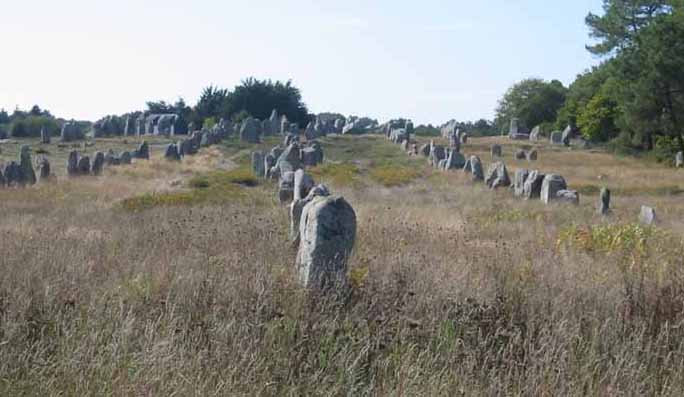
As part of the Celtic heritage that Brittany shares with Great Britain are the stone circles that one finds throughout the peninsula. I don’t know if there is anything to the old gods, but there is definitely an unearthly feel to these places. Though there’s nothing on the scale of Stonehenge, the megalith sites still can awe and amaze. On the day we were there, the clouds were low and a mist hung in the air. Could I hear the chanting on the morning of the solstice, when the sun would rise straight over the heel stone?
On our last day there, we drove up the coast to the small city of Quimper, which is the capital of this Celtic province. It is here that you will hear Breton spoken on the streets. It is known for two art forms, the complex doilies that they have weaved here for hundreds of years, and the Calvados that they distill. Calvados is an apple brandy that is drunk much more that its grapey cousin. Mary and I took in a tour of a factory that was marvelous. By the time we were there, we had been in country for two weeks so we had gotten pretty good at our French so we took the entire tour without subtitles or translation or anything. I think we were both pretty proud of ourselves.
As a historical note, the Celts are usually regarded as inhabitants of the western isles of Britain, but before the Germanic tribes like the Franks and the Goths overran the region they were the predominant peoples of not just Britain but France and Spain. The Goths migrated over a remarkably short period of time (a few hundred years) all the way across Europe from the Ukraine through Iberia and all the way to Morocco, which was conquered in the 500’s by the Vandals, a tribe of Visigoths (and unfairly blamed for messing things up everywhere; they were actually pretty civilized). By the same token, earlier the Celts spread east, specifically, the Galatians of New Testament fame were Celts who migrated to Anatolia around 200 BC.
Normandy
North of Brittany is Normandy, named for the Norsemen, that is, the Vikings. This part of France was conquered like much of Europe by the outflow of energy from Scandinavia. Normans settled in many parts of the world including Sicily which it ruled for several hundred years and from there bedeviled the Byzantines, and in the Levant where they obtained a foothold during the Crusades. The most famous settling places for the Vikings were in the western provinces of France. The raiders would plunder, then settle, then marry your sister. From this launching point, the bastard son of minor nobility conducted the last successful invasion of the British Isles, defeating the resident Anglo-Saxon king who had just defeated the invading Scandinavian king just in from Sweden.
Of course, more recently Normandy is thought of in light of the invasion of the continent in 1944 against Hitler’s Atlantic Wall. So many different kinds of good fortune accompanied that invasion that could have failed a thousand different ways that it seemed the last time God was on our side unequivocally. My father-in-law was of that generation, and our trip to Europe with them was focused on him seeing the battle scene. On the same day, we visited Ypres in Belgium, Dunkirk, and finally Omaha Beach.
A few observations are unavoidable as you drive down the coast. We had the hard job, by far. Sword, Gold and Juno beaches are flat and the approaches are difficult to defend. The Brits and Canadians took these. Omaha Beach was the most devilish spot to attack, almost as if we were trying to find the nastiest place on the whole coast to assault. You stare up at sheer cliffs that were studded with redoubts and bunkers, a killing field if there ever was one. The view off to sea from there shows that all a German soldier would have to do is spray ordinance everywhere and you were bound to hit something. And once the attackers hit the mine-infested beach, the only safe place was right next to the cliffs and God knows how paralyzing facing those obstacles was.
And on the top of the cliffs, the contrast between the wild grasses of the coast and the perfect green of the cemetery with the alabaster tombstones leaves you gobsmacked, speechless, and awed. As you rotate, around every 30 degrees or so is a perfect line. Turn further, another perfect row. Boys from Iowa, men from Maine, cowboys, factory workers, all mixed together well and deposited on a beach to do the impossible. Some went further, and others stayed forever. I can describe the scene, but I cannot describe the feeling. It’s something can only be experienced by yourself, alone, silently. We romanticize battles and victories and great feats by generals and kings, but this is one moment in time where the heroes were each man that faced that cliff.
In contrast to this is Ypres, in the southwest corner of Belgium. Where Normandy is a confined region with a singular focus on that cliff, Ypres is everywhere. There were spots that played a particular role, say the hill of Passhendaele (so appropriately pronounced “passiondale”), but for me the motive thought was that everyplace saw the same futility and death, despair spread equally across the fields. The landscape is very much like eastern North Dakota, flat and generally featureless, with every square meter under cultivation. Like every section of land having a farmstead here, there every section has a cemetery. You see them scattered in every direction you turn. As we couldn’t see them all, we picked one at random to take stock in.
Surrounded by well-tilled fields is a concrete wall with a wrought iron fence. Stone tablets are lined up in rows, many of which read “Known but to God”, but others were from the same place, Fort Garry. This is just north of the border from us in Winnipeg, Manitoba. I am sure every other cemetery had similar stories, men from a single region or even neighborhood, lying forever in a Belgian field. The triumph of part two of the Great War is juxtaposed with the indeterminate outcome of the first part. The German populace was told that they were winning up until the last moment when the armistice was dropped like a bomb on them. To save face, the militarists allowed word to spread that Jews “stabbed the nation in the back”. But here in a Belgian field, that part of the story would never be known. Here it ended among the craters filled with mud because the water table is only just below the surface. This is because you are only a few miles from the ocean. What I’ve always wondered was, what happened at the beach? Did the trenches go right up to the water? Did they go up and down with the tide? Was there some lonely guy at the end, waving across at his counterpart?
Southern France
At the opposite end of the country is Arles, the land of Vincent’s sunflowers. For a short period of time, Van Gogh called this provincial city in south-central France his home. It was here that he committed himself to a sanatorium to take refuge from the demons that haunted him. A two-tiered hospital surrounding a courtyard filled with bright flowers, nearly as riotous as he saw them. Throughout the town are reminders of two defining forces, the towering genius of Vincent and enduring mark of the Roman Empire. The arena in the center of the city is in the mold of the Coliseum of Flavius, with other artifacts such as baths and the house of Constantine before he swept across the later Roman world to the last great ruler of the Romans.
What divides the greater half of Arles from the lesser is the Rhone River, the aorta of south France.  As you travel north there is the city of Avignon, and as any grade school student of French can sing, “Sur le pont d’Avignon, on l’y danse, on l’y danse”. “On the bridge of Avignon, we all dance there.” Why, who can say? We came, we saw, we danced.  I am sure the locals are sick of American tourists who happened to choose French rather than Spanish in 4th grade dancing their insipid little dances. But from this bridge that only now reaches halfway across the Rhone, you look back on the ramparts and walls of Catholicism in exile.
During the turmoil of pre-Renaissance Europe when power in Rome meant power in the rest of Europe and the Holy Roman Empire was “neither holy, Roman or an Empire”, the line of popes that we have today was on the short end of the stick of power. They suffered exile under the protection of French royalty in the castles of Avignon. What is left behind there is impressive from the outside, with walls and ramparts that look eminently defensible. From the inside, however, it is remarkably spare and desolate. If it ever was filled with the trappings of eternal power embodied by earthly men, it’s long gone. And yet the history that remains stands out all the clearer for me because of this. Here were mere men, forgotten to all but scholars, but engaged in a political war for the most single powerful and long lasting institution for the last two millennia. They win; skive off to Rome, leaving behind the empty corpse of a building like a chick leaving its shell.
As you head the other way, downstream from Arles, you find the many mouths of the Rhone, into the delta of the Camargue. This reminded me more of the land south and west of New Orleans. There were horse farms and salt marshes, canals and dirt roads. Horizons appear the same in all directions: stunted trees, tall grass, air that is thick with the smell of decaying vegetation and brackish water. As you head further south, you see a medieval fortress town of Aigues-Mortes, roughly translated from Latin through French as “dead waters”.  This served as early France’s port to the Mediterranean and was where two crusades were launched. Now, it’s a wall, and the town inside is an amusement park on the way to the beach, “Medieval Land”! Okay, I exaggerate, but only a bit. It looked pretty touristy, but we didn’t stop so I can’t say for sure.
The end of the road for us that day was the beach, the only time I’ve been to a European beach during the high season. You drive through La Grand-Motte with its McDonalds and condos and marinas a little bit further into the dunes and natural sand forms of Espiguette beach. My kind of beach, a lot like south of Nags Head. It was anything but deserted but it was also wild and unsettled. The gray of the Mediterranean was not inspiring, the passing clouds cooled the day so that there was no need to get into the water to escape the sun, but it still was the place to be. Kids played, families read books. Bathing suits were like French attitudes; maybe yes, maybe no, maybe there but just barely. Nobody seemed to care, everyone there in the crowd but not minding the business of others. I liked it.
Central France
The only time I have been to France and not played the part of the tourist was when my nephew Tom got married just east of Lyon, at the far other end of the Rhone. Lyon is not Paris. There are of course resemblances, I mean, cathedrals, parks, that certain flair that French women have no matter what their age or station in life, but it starts to diverge there. Lyon is gritty; it’s a city that is more industrial, more hard-edged. It would be Pittsburgh to Philadelphia, Oakland to San Francisco. What it has but I can’t speak of first hand, is the finest chefs in France. Even Parisians acknowledge this. It is not for nothing that Jacques Pepin is from Lyon.
Tom’s wife Carine is from a town around 20 kilometers east of town as you reach into the lower foothills of the Alps towards Zurich, the hamlet of Villieu. I wish I could relate my initial sense of the place. I was in shock, in part from travel, in part from the stress of leading my brother and his family through a trans-Atlantic flight and subsequent disasters-in-series. We barely made the flight out of Boston where we met up, landing in Barcelona where everyone’s luggage but Mary’s and mine were lost, staying in a cheap hotel just off the airport but far away from any part of Barcelona that one would wish to see, then a drive up through central France in two cars, communicating by flashing lights, finding a town that none of us were quite sure how to get there. Nerves were frayed and the famed family crankiness was in high gear.
We found Carine and Tom who lead us to our B&B in the even tinier town of L’hopital several miles south.  Our new home was in a village of a few hundred people whose name derived from the fact that there was an ancient hospital in town, probably more like a sanatorium in its day. Growing organically on a decidedly non-grid pattern, in the hot of summer the wheat fields that encircled the town felt like you just walked into a Van Gogh. I found an afternoon to run one day during our stay. There were no shoulders on which to escape traffic, and any breeze was extinguished long before it reached me. Locals stared as I ran past as I am sure they had at least a rumor that strangers were in their midst. No waves, just looks.
The wedding preliminaries started well before the actual ceremonies. We gathered in our Sunday best in a field behind the town hall that would have had a softball backstop had it been in the US. Non-English speaking family would wander by and pay brief respects with a friendly wave and handshake but rarely anything we could respond to. Although Mary and I can ask directions and function on a low level, any conversation beyond asking about the health of one’s family is an exercise in frustration for both parties. A few characters stand out for me. There were grandparents in wheelchairs, one of which served with valor in the resistance but now needed a young man to wheel him around. There was the bride’s brother Patrick who had quite functional English and was most gregarious. The bride’s parents spoke no English at all, but still showed us the utmost in hospitality. (I need to tell a story on Patrick. He came to the US for a holiday along with Tom and Carine. They took a drive into rural Virginia and West Virginia, where he was determined to see some cowboys. The fact that there are no cowboys of any authenticity in those states was no deterrent at all. I believe I heard that he had purchased and proudly wore a cowboy hat, likely the only one in West Virginia that day unless Brad Paisley had a concert there.)
After numerous pictures were taken and some measure of order was imposed upon the throng, we all retired to a room in what passes as city hall. The mayor performed a civil ceremony in French that involved signing papers in the presence of all. The fact that Tom was signing a legal document in a language I doubt he spoke more than a few dozen words always made me wonder about the legality of it all, but I don’t think he was the only man who was not clearly aware of what he signed in that situation. We joyously retired across the street and into a town meeting hall that had been prepared for the occasional more like a state visit of a dignitary more than a wedding reception.
That’s where things get a bit fuzzy for me. We were seated next to Uncle Pierre, who was fluent in English of the most ribald and hilarious variety. The champagne tower was constructed with glasses that were filled from above by the happy couple. A band performed with recorded music but fronted by a chanteuse who changed costumes it seemed with every song, changing from cancan to disco queen to cowgirl complete with chaps and a toy pony stick to ride. I remember a camera and a picture frame where you were supposed to mug and embarrass one self. There were crossed French and US flags on the wall, and my brother and I were to show proper fealty to the joining of our nations like the joining of Tom and Carine. As the glasses of champagne accumulated, I have more and more ethereal wisps of memories, thanks for Normandy, praise for the Marquis de Lafayette, disco lights, conga lines, a bizarre song where you were required to swing your napkin over your head. Somewhere deep into that night, I remember starting the car, and aiming it where the lights were, praying that the path would lead me to L’hopital, knowing I was quite legally drunk in a land of the Napoleonic Code where the burden of proof of innocence is on the accused and I had not a legal leg to stand on and almost not a temporal one either. Driving oh so carefully and deliberately, my entire focus on where those lights were and keeping those lights on the road ahead, the town, the driveway, the door, and we flopped into bed, sleeping the sleep of the dead or nearly so. Noon was nigh when I became fully aware that I had a pulse and a new day had dawned.
We were charged the following day to cleaning the mess left behind. There were the leftovers of day to be consumed, some delicious French versions of sausage and head cheese and stuff I likely wouldn’t have countenanced under normal circumstances, but even a hung over me loves good cheese and sausage. What I remember most clearly is some very lovely cousin approached me and stuck her face right in mine. Totally caught off guard for one of those distinctly French double cheek air kisses from a beautiful girl, I am sure I turned twenty shades of red from embarrassment. Because, no matter how I pretend, no matter how I try, I am still hopelessly American.

Wednesday, June 8, 2011

Paris


Paris
Whoever doesn’t love Paris upon the first day visiting is not my kind of person. I am sure that I know someone who hates it, but I would appreciate it if they didn’t share that opinion with me. It is likely the most enchanting city I have ever seen, and if I could figure out a way to afford to live there, I would. Why is it so addicting? I could muse on that all week and not come up with a single satisfactory answer. Yes, the food, the history, the culture, but none of that even comes close to capturing my love for that place. It has that certain je ne sais quoi.
My first visit to Paris was when I was 15. I had been struck with gastrointestinal distress in Rome, but I was better by the time we got to Paris though the rest of my family was ill by then. I remember not being impressed at the time. My poor high school French didn’t seem to be very useful, and wandering around by myself without a great deal of money wasn’t much fun. I remember eating in a Wimpy’s hamburger restaurant on the Champs Elysées, going to Notre Dame, and not much more. We stayed in the Hotel California (before the song came out) about a block from the Champs. It was across the street from the printing presses of the International Herald Tribune, and at 0500 they would unload giant rolls of newspaper ready for the ink. It would hit the pavement with a resounding “boom”, four or five in a row. So much for sleep.
So when we lived in Iowa and had a vacation to burn, going back wasn’t something that I was totally enthused about. Mary took French in high school and college but had never used it except in Quebec, so it was a dream come true for her. In the days when the Internet was in its nascent form, we assembled info from the French Office of Tourism. We found our apartment through a couple that advertised in the AAUW magazine, and we let Henri and Nancyhelen do our planning for us.
So as a historical overview, Paris was like many European cities, starting out as a Roman fort. In the River Seine, there were two islands where it all began, Ile de la Cité and Ile Saint Louis. As the Romans left and the Germanic tribes started to turn Latin into French, the city grew on both sides of the river. The gothic architecture that I associate so strongly with France started with Saint Denis. The gruesome story was that he was decapitated for some infraction, afterward he took his head in hand and walked north several miles and where he stopped is where the cathedral of St. Denis was built. It became the burial place for French royalty; so if you wish to visit Marie Antoinette, take the Metro to Saint Denis.
The Paris that we see now is not the Paris of Kings Louis I-XVI. It was a medieval city surrounded by a wall, and within that city were all the necessities of life. You would have butchers and tanneries and all sorts of noxious gases and fumes. Civic planning wasn’t something that occurred to anyone until the mid-19th Century. It was then that Georges-Eugene Hausmann was commissioned by Napoleon III to start all over again. The city walls were destroyed and were replaced by the Periphique, the road surrounding the city. Long stretches of slums were razed and replaced with the grand boulevards that we associate with the City of Lights. The facades that are nearly identical from place to place were also part of his grand plan to make the city breathe again.
The cultural life of the city has always been paramount in its character. Benjamin Franklin made his reputation by being seen in every salon and boudoir in the city. Chopin loved George Sand there, Oscar Wilde died in a cheap hotel room, and Hemingway and F. Scott Fitzgerald had their most creative years drinking until dawn and writing all day.  Stravinsky debuted “The Rites Of Spring” there, causing a riot. (I can’t imagine folks dressed like the guy in the Monopoly game tipping over cars and burning couches in the streets.)
Paris is a city of neighborhoods, and in Paris that means arrondisements. It starts in the middle, where the Romans started it all. The First are the city islands and north bank. They then circle outwards like a spiral, counting up to 20. As you go outwards, the Paris that we know is replaced by nameless apartments filled with Africans and Algerians and other products of empire. Paris has its share of the homeless and crime and filth, but it’s so charming in doing so.
On our first visit, we rented an apartment in the 5th. It was on Rue de la Montagne, just down the hill from the Pantheon.  It was on the third floor of a building that was above a flower shop and an Italian restaurant. As you walked down the hill toward Notre Dame, you entered likely the oldest part of the city that wasn’t on the city islands. The streets that had been broad and straight became narrow and not on a grid. As you walk a bit further you can see the Seine with docks for the bateaux mouche, the tour boats that take you past the sites along the river like the great cathedrals, the Eiffel Tower and the Louvre. If you walk west from the apartment you go past the Sorbonne, or at least one of the many branches of it. It is called The Latin Quarter because of the presence of the university and the Latin that was spoken there. Just past this are the Luxembourg Gardens, with abundant flowers and fountains.
Through the wonders of the Internet, you can see the street view outside the apartment we rented, 20 Rue de la Montagne, Paris 75005. The this-and-that shop one floor below, the bistro across the street, a little further north towards the Seine, you see the police station. As you reach Rue Ste. Germaine, there is a market that occurred on Tuesdays and Saturdays, with all the veggies one could desire, flowers, and etceteras. Across the street from the market is the entrance to the rest of the city, La Metropolitaine, a.k.a., The Metro. This particular stop was Maubert-Mutualité. Home.
The metro is the transport of choice. It is clean and safe, there are often accomplished musicians busking, and is something I look forward to using. If you are wise, you purchase a “carnet” when you first get there, a proposition where you purchase ten tickets for the price of eight, or something the same. You go up to the window, “Un carnet, s’Il vous plait.” You don’t need to know a great deal of French, but know your numbers, up to twenty.” “Merci”, “s’il vous plait”, “de rien” (“you’re welcomed”), “au revoir”, and your numbers, that should get your through. It is easy to get an app to help out with navigating the Metro. I even had one on our ancient Palm Pilot years ago that would take your origin and destination, tell you how many stops and which trains to catch.
As I said earlier, it all starts at the center. Ile de la Cité is where every good tour of Paris has to start. The obvious landmark is Notre Dame. It is the grand cathedral of the French nation. As to when it was built, etc., I will leave to the guidebooks, but one story that stick with me. The Catholic Church and the French monarchy were in bed together for several hundred years. When the Catholic Church underwent schism in the 1300’s, one contending papal line was housed in Avignon for 70 some odd years under the protection of the French king. Time marched on through the Renaissance and the Enlightenment, and the influence of intellectuals like Rousseau and Voltaire, revolutionaries like Jefferson and Franklin, and the ineffectual monarchy created the conditions that gave rise to the French revolution. As the Enlightenment was at best an agnostic affair and the populace saw the Church as being the agent of the monarchy, the trappings of religion were destroyed all over the country and in particular in Paris. The effigies of the kings that guarded the entrance of Notre Dame were destroyed and the great church was turned into a stable. Over a decade or two, sanity prevailed but the damage had been done. The old heads are displayed at one of our favorite small museums, The Cluny. (More on that later.)
If you stop at Notre Dame, you will be like most tourists. But I expect oh so much more out of you. The hidden treasure of Ile de la Cité is a smaller cathedral, one that is more difficult to get to. In the Palace of Justice where judges try criminals, there is the cathedral of Sainte Chapelle, the private chapel of the kings. You have to go through security, past men holding uzis wearing body armor, and have your bag searched, but trust me, it’s worth it. The walls of the cathedral are the slenderest of pillars holding up the high vaulted roof, and between these pillars are the most gorgeous stained glass. If the sun is out, you sit, just sit. The lights dance as the sun moves, and a great deal of time can pass before the thought of moving occurs. On a later visit, we had the incredible pleasure of hearing Mozart’s Requiem performed by a chamber orchestra and small choir. It was a cool autumn evening and I was with my in-laws and wife. The angelic contained within the divine.
As you walk east, on the south side of Notre Dame by the Seine, there is a small bridge that crosses between this island and its sister, Ile Saint-Louis. If I had to live in Paris, it would be here. There is a nice bistro on the east end of the bridge that is worth stopping at only to marvel that you are actually within the presence of Notre Dame. You sit, sip wine, eat your cassoulet, and just be. As you walk down the central street towards the east, there is a must-stop and a must-continue-to-walk. The stop is at Berthillion ice cream shop. Get a cone of something closer to Italian gelato than Ben and Jerry’s. Delicate little cones (get a double, side by side scoops) and taste the sweet goodness. You can’t go to the isles and not do Berthillon’s.
The must-avoid looks good enough, from the outside that is. The name of the restaurant is Taverne du Sergeant Recruteur. The story supposedly is that the Sergeant would get a recruit sloppy here and shanghai him into the service. They’ve been playing on this chestnut for decades. I don’t know if I am wrong or others are, but TOURIST TRAP is written all over it. When we went there, the only French spoken was by the waiters and only when they talked to each other. At a neighboring table, a woman who was a tour guide to a bunch of little old ladies told almost her entire life story to her rapt audience, well above the din of the packed house. Another American guy at the table opposite leaned over with an audible groan as she launched into another self-serving tale and expressed the need to either shoot her or himself. The meal took quite a while to make its appearance and I only remember that I wasn’t impressed. Towards the end, we hear the thumpety-bump-bump of someone falling down the tiled stairs into the basement about ten feet away from me, something you would never have in the US because it would have had yellow stryper tape all over it. A man’s voice yells, “My God, she’s dead!” A gasp rises from the dining room, and I get ready to launch into action. From the bottom of the stairs comes a woman’s voice, “No Herbert, I’m fine, help me out of here.” We left with a fair amount of dinner on our plates, glad to leave the horror show and happy to be in the streets.
On the north shore is the rest of the first arrondisement. This is where you find the Louvre, Les Halles, and the Pompidou Centre. The Louvre is a place that I think it an imprisonable offense if you don’t go, though for me it’s not my favorite museum by a long shot. The key to the Louvre is to avoid the interminable lines by getting your tickets elsewhere. At the Metro stop you can purchase the Paris Museum Pass, giving you entrance into this and many more must-see-ems. You walk past the unwashed, stupid hordes like your merde doesn’t smell, present your pass and you’re in. Once in, realize that you can’t see it all, you can’t see half, you can’t see a miniscule part. Go see Winged Victory, go see the Monets, go see the Mona Lisa. The problem with the latter is that you aren’t the only ones who wish to see it. It truly is tiny and you are competing with Japan. The entire nation. They are shorter, and they are pushier than you.  You will find yourself swimming against the yellow tide. They leverage you up against the wall because they don’t mind subways in Tokyo while all of that human flesh makes us afraid of losing wallets and groping and general ickiness. Surrender now and go someplace else.
Out in front of the Louvre is a place where Parisians go, the Tuleries Gardens. The French know how to do gardens. Not a leaf out of place, flowers arranged by color, beautiful women wearing their scarves just so sitting on benches reading Sartre. Continuing onward you approach Place de la Concorde and Champs Elysees. You have to see it, without a doubt. You have to walk it, all the way to L’arc de Triomphe, that monument that allows the French nation to forget that Napoleon eventually lost. You must make this walk. But I won’t tell you about it, guidebooks will do it better and I have other pêche to sautée.
As you approach the arch from the south, consider turning right instead. Just past L’Opera and next to Gare Sainte-Lazare you will find shopping heaven. There are two department stores to beat all department stores, the place where you can be as au courante as you like, Printemps and Galleries Lafayette.  They are next to each other and indistinguishable from my perspective, but I am sure my wife can straighten me out here. It’s a total waste of my time to wander the men’s section because I am not French. I can’t buy shoes there, they don’t do size 13. Seriously. Frenchmen are trim at the waist, ride bikes up alpine roads, and play soccer. American men eat cheeseburgers, have big butts that you show movies on if you wear white pants, and have no ability to know how utterly goofy they look. Any self-respecting Frenchman would commit suicide if he were told to inhabit an American’s body. I am serious, I have waited in line looking as Euro as I could. The guy taking money for whatever would say to the others, “Merci, merci”. I get to the front of the line and hear, “Whaddya want?” Never have I been greeted in French.
I digress. My favorite story about Mary’s Printemps experience was that at the top floor we happened upon a salon. I could see her face light up. “Okay, go!” I told her, knowing she was about to enter nirvana. I wandered about, looking at clothes cut for a few folks that I knew that would eventually join Beta Theta Pi or some sort but not me in this lifetime. Anon Mary emerged aglow, hair actually looking quite French. A gay guy named Guy (I love that alliteration) had transformed her, and as we walked to dinner, she floofed and swished all the way in a manner I have not seen before or since.
Continuing the spiral eastward, you head upward in elevation and downward in culture. Montmartre has been a place where one could find what one wished when one desired. Noted for its Folies Bergere and Les Deux Magots (where Hemingway drank while he wrote), I can’t speak to the history of much as I don’t find it terribly interesting. American alcoholics escaped prohibition and found cheap housing in post-Great War France in this neighborhood, but I’ve never seen much reason to look further. What I think is more interesting is what’s at the top of the hill, Basilique de Sacré-Coeur. It is if the grandiosity of the Gothic era meets Monet’s impressionism. Instead of peaks and spires, you have domes. A mosaic of Christ in the inner dome is in softer colors, with gentler sweeps of hair and beard. The Catholicism that I was raised with is more apparent here than either the barbaric gargoyles of Notre Dame or the fantastic kaleidoscope of stained glass of Sainte-Chapelle. This is the Jesus with halos and stigmata and visible-from-the-outside hearts ringed with thorns. This was no symbol like the vacant cross of the Protestants.  This Christ bled for you.
Well, this wasn’t an accident. When the basilica was built, it first of all cleared out a whole bunch of low-income folks. It was built in the aftermath of the crushing defeat of the Franco-Prussian war, demolishing the pride of Napoleon’s children. The French government had abandoned Paris when the Prussians occupied the city, and after a peace was struck, had moved back into Versailles. A move by the army to recover a cache of arms in Montmartre caught the locals by surprise, and an instant rebellion was born. Rabble-rousing socialists seized the opportunity of combustible poverty and unrest and thence mushroomed into the Parisian version of Communist Soviets, the Communards. The false spring of revolution collapsed as quickly as it arose like a spoiled soufflé. Tens of thousands of rebels were killed or deported, and a neighborhood was razed.
The empty space left behind was filled quickly. Conservatives are always religious in France, and the Sacre-Coeur was an offering of penitence to an angry God who had favored the Boche this time, and a way for the Church-Regime alliance to have a win-win. The Church had a monument to the bishop who had been captured and killed by the agnostic socialists, and the state gets a place to honor the soldiers who died fighting Prussia. What we get out of it is a great view. This vantage point gives us the best view of The City Of Lights, even better than the Eiffel Tower in my opinion. From the esplanade in front of the church, there are paid binoculars where you can focus in on Le Louvre, Notre Dame, the great downtown version of Sears, La Samartaine, and to Les Invalides and the Arch of Triumph as you scan west. Descending from here are a series of stairs that circle downward like Maureen O’Hara descending Tara’s steps, meeting on a platform then circling downward again to the next platform. All the while you see statues and sculptures and pigeons by the thousand. Please watch “Amelie” and you will get the effect of the drop in elevation.
Our next stop makes us go back into the center city, into the 4th arrondisement. This is where you find La Marais neighborhood. This has traditionally been the Jewish neighborhood, and it is particularly notable for one fact that I only discovered by experience. Paris can be quite boring one day of the week, that is, Sunday. All of the tourist spots that require an entrance fee close up and most of the restaurants do too. This is true everywhere but The Marais. Parisians know this, too, and the place comes to life with good places to eat and art museums, etc. It is also reputed to still be an inexpensive place to live. If you know your French, you know that marais means “swamp”, so I guess the Jewish community knows land that has a good chance to appreciate. As you go a bit further east from here, you will see the space left behind by La Bastille. That’s because it isn’t there. Just a big square. Imagine if you will a grand fortress and prison where only about seven people were liberated and two soldiers died and now we have an excuse for waiters to race in the streets carrying glasses of champagne. My suggestion: if you drive past take note, but otherwise there are better things to see.
One thing that is inevitable in a city of such antiquity is the problem of dealing with the dead. With the prohibition in Catholic countries in particular against cremation, two thousand years of a city’s existence tends to have a lot of dead bodies accumulate. Generation after generation were buried and when all the graveyards filled up, they would be emptied and the process was started again. From the emptying of the cemeteries and by moving the remains into the mines and sewers under the city you have the famous Catacombs of Paris. Grim thinking, but necessary before I launch into my next point of interest.
As you head east out of the Marais district, you encounter one of my absolute favorite sites in the city, Pere Lachaise Cemetery. As only the rich can afford to be buried in a place where you can be guaranteed not to be eventually cleaned out for the next generation of the dead, they built family mausoleums that were meant to last a very long time. Pere Lachaise is a city of the dead, right up there with Ricoleta in Buenos Aires and the above ground cemeteries of New Orleans. There is row after row of marble houses containing entire families, often whose names are known even to the likes of me. Without much effort, you find the graves of Yves Montand, Edith Piaf, and Sarah Bernhardt. There are a few graves with special meaning for me.
To start with my favorite, I adore the music of Chopin. My father also loved his music, and some of my earliest memories are of Dad fighting his way through a Polonaise or Étude. As I aged, my appreciation only grew. With my adulthood and the marvels of CDs, I now own the complete piano works of Frederic Chopin. (My Dad would be so incredibly envious.) Chopin was born in Poland but moved to Paris to follow his music career. The piano was less than 100 years old, and he was celebrated as its master very early in his life. He developed a relationship with George Sand, who was not a man as you would expect. Her nom de plume was male so her writing would be taken seriously. His career was cut tragically short by consumption, like all great artists of his day. He died at age 35.
His grave is the most tragic sculpture of a weeping angel. This monument is almost always adorned with bouquets of roses. I saw the pictures since my infancy. As I grew to appreciate him more, I knew I needed to make a pilgrimage to his grave. As I got there the first time, almost enraptured as I searched for it on a map, it was behind corrugated metal. Under repairs. I tried to peer between the metal plates, to almost no avail. I could see it was stone in there. I have not returned to Pere Lachaise to actually see it yet, but I will God willing.
When we arrived the first time, there was a controversy on both sides of the Atlantic. Jim Morrison is also buried there, but as you don’t buy your space there, you rent it, apparently the rent was past due and he was about to be evicted to somewhere else. It also had been a source of conflict for the local police, as people were in the habit of holding midnight parties there, drinking and doping and grafitti-ing. In light of this, we left Chopin and found Morrison’s grave. It was hovered over by a bored looking gendarme. There were several people there, none of them looking particularly counter-culture. Just a small tombstone. Behind me, I heard middle-aged women talking. “Who was he, do you know?” “I think he was a drummer in the Rolling Stones.” I resisted the urge to act incredulous then launch into a detailed history, but not everyone is going to get The Lizard King, even if explained in detail. (In something I just learned from Wikipedia, punk rocker Stiv Bators will spend eternity there because his ashes were scattered over Morrison’s grave.) As it turned out, nobody was evicting Jim for whatever reason.
One last grave needs a story. Oscar Wilde was gay when gay wasn’t cool. Because he had a relationship with the Marquis of Queensbury’s (i.e., the guy who codified boxing) son, he was eventually convicted of being a sodomite and spent several grueling years in prison where his health and wealth was destroyed. He died alone in a squalid Paris hotel. He was buried in Pere Lachaise by the grace of a very rich female admirer. The grave was a very large marble block about the size of a small trailer, carved in the style of Egypt, as that was all the rage at that time. There was a pharaohesque male figure as part of the carving, one with a rather outstanding male member. This offended the grave keeper at the time, so it was knocked off and spent several decades as a paperweight on his desk. (I am not sure where it is, presently.) As you approach the tombstone, you see it covered with lip marks. It is tradition that any woman must kiss the stone, preferably wearing lipstick. I sat at the base of this monument for quite some time, enjoying being in the presence of one of the finest wits of all time, and I strongly suggest you watch the movie, “Wilde” starring Stephen Fry.
We will continue to circle clockwise through the city and cross the river once again. We next go to the 5th arrondisement, the location of our apartment. As you walk toward the Seine, if you head a little west you may encounter the Cluny Museum. It was placed on the site of Roman baths and subsequent to that a monastery. What I love about the Cluny is that it preserves the middle ages, or the Moyen Age in French. You will see the disembodied heads of the original kings of Notre Dame, the remains of the caldarium of the baths, and the Lady and the Unicorn tapestries. I have a phenomenally clear memory of our visit there as we heard a band of medieval musicians perform the songs of the itinerant musicians of the day. My personal memory was that we were sitting behind this young woman with incredibly luxuriant blonde hair drawn into a very long braid, watching her head bob with the music that varied from joyous to mournful, primitive drums and early stringed instruments and recorders. Lovely.
Traveling west along Boulevard Saint-Germaine you will come to La Musée Orsay. This contains many, many items from French art of the last several hundred years such as textiles, furniture, sculpture and painting. At the very top floor is the née plus ultra of the museum, the Van Gogh paintings. It has the most extensive and best collection in the world. Take my advice here, please. You don’t have to start at the bottom and work your way up to the fourth floor. That’s what everyone does. By the time you get there, you will have to fight a crowd. Start up, go down. Then you have you and Vincent, just you two, and nobody to interfere. But a trip to Paris without a trip to the Orsay is incomprehensible. Skip the Louvre. Don’t skip this.
I save for last something that I really don’t have a great deal of connection to, the Eiffel Tower. It was built as part of an exhibition in the late 1800’s. Like the Sacre-Coeur, it was roundly reviled as not being Parisian, and there was a movement to get it removed ASAP. Well, you don’t need to be told the rest of the story. Anyway, from the base, it covers a phenomenal amount of territory. You can take an elevator to the first level or take it to the top. It’s expensive, and I’ve never been able to rationalize it. One chunk of advice, though. Rick Steves has written about a nearby neighborhood as being a wonderful place to stay and visit, thereby utterly destroying it. If Steves likes it, stay away, on the whole, or at least, expect it to have been ruined.
There are places to see just outside of town, the most popular would be Versailles. Take the RER (the commuter train that you pick up just on the south bank of the Seine from Notre Dame). It’s a bit more challenging than the Metro but still doable. Go see the gardens and the boudoir of The Sun King, and the fake peasant village of Marie Antoinette. See the Hall of Mirrors where the Treaty of Versailles was signed. But by all means, get there before 11AM when all the tour buses arrive. You must beat them, or you will swim in the same yellow sea you encountered in the Louvre. You can also go to Giverny (Monet’s gardens) by rail, though I’ve never been. I also strongly suggest you go to Saint-Denis in the northern suburbs near Charles De Gaulle Airport, where you see the effigies and tombs of the French monarchs going back hundreds of years. You can get there by Metro.
My last place to tell you about is everywhere. My favorite thing to do is to walk, totally without destination. I have happened upon Chanel’s original shop, the Israeli embassy (armed to the teeth), and the biggest map store I have ever seen found during taking cover from a driving rainstorm. (I was wearing a hat that had gotten utterly destroyed from the rain. I remember a beautiful young woman with a dress saying, “Votre pauvre chapeau!” as I walked past, (“Your poor hat!”).) You don’t need a destination. Wonderful meals can be had from bread stores. You buy a ham and butter baguette and a cheap bottle of red, sit in front of Shakespeare’s English bookstore on the banks of the Seine overlooking Notre Dame, and you have an unforgettable meal. Paris doesn’t have to be expensive, and it doesn’t have to be an aerobic exercise of seeing sights. Get on a double-decker tour bus open to the air, and ride.
There are so many adventures to be had in this city, I don't think you could ever wear it out. If I had to live in only one place for the rest of my life, it would be here. I haven't even mentioned the food, but I don't have to. Find a bistro, order a bottle of your favorite type of wine, and remember that French food is more than boeuf bourguignon. They also do a great job with sausages and kraut and beer and desserts like Floating Island. Don't wait for me to point you in the right direction. Pick something whether you can translate it or not and enjoy. Except don't order the cheval. That means "horse".

Sunday, June 5, 2011

Puerto Rico


February 2011
PUERTO RICO

Mary and I had wanted to go to Puerto Rico for years but there were always something more pressing or more interesting. Either we had a specific goal or a request from my mother-in-law to see something else or some other place caught our attention, but the stars never aligned. What made us finally decide to go to PR were two items: one of my best friends at work was from the island, and Tony Bourdain had one of his shows that made the food look really good.
I already had some contact with the culture of Puerto Rico during my residency. In Massachusetts, one of the many ethnic groups I had to deal with was from PR. I learned to deliver babies in rudimentary Spanish, I found that puertoriqueños are very expressive in showing pain. The contrast between Hmong women and women from Puerto Rico was remarkable. You couldn’t tell if a Hmong woman was contracting without looking at the monitor, whereas a puertoriqueña was yelling “Ay yi yi!”, her mother was yelling “Ay yi yi!”, and at least five sisters were having sympathy contractions.
Part of the larger picture of living in Massachusetts was the incredible niceness/rudeness of the natives; you never had to guess how people felt. Another thing that Mary noted was the panoply of ethnic groups that continued from generation to generation. One was Portuguese, or Italian, or Polish, or Irish. The melting pot did not exist. It was a stew. Mary would get her hair cut in a beauty shop inhabited by Italians, about the same time “My Big Fat Greek Wedding” was part of our pop culture.  They would gossip loudly and Mary got to be the outsider who became the insider. I mean, someone had to listen to the same old stories afresh. Once in a while I would get my hair cut there, and I became notable because I was that nice librarian’s husband, the “dahktah”!
My impression of Puerto Ricans was not a good one. I saw them as mostly on welfare, suckling at the teat of mother Massachusetts. A doctor from Puerto Rico whom I worked with told me that I was not getting an accurate picture. According to her, if one had a job or was a productive member of society, there was no reason to leave the island. I was seeing the parts of their society that floated around the edges, ones that had enough ambition to move to the US proper but not enough to contribute.
One common thread in our lives here in North Dakota is our desire to shorten winter, some how, some way. Usually this takes the form of a trip somewhere tropical. We were torn between the familiar in Mexico or something new, with the overall grand scheme of finding a place to spend our dotage. It has to be cheap, it has to be warm, and it has to be interesting. Living with a foreign language isn’t daunting to either one of us, as we both seem rather facile with Romance languages. PR has the advantage of being America, well, sort of. They use dollars, English speakers should be ubiquitous, and American infrastructure should be everywhere. Modern highways, bathroom facilities, even NPR should be there. It should be easy to get to, as flying from the States should be cheap and direct.
I think it was David Bowie who once sang for the movie, “The Falcon And The Snowman”, “This is not America. Oh, no!” He could have been singing about Puerto Rico. They have the distinct status of being neither fish nor fowl. They spent 400 years as a territory of Spain, the jewel in the Spanish crown. It is halfway between the ports of Cadiz and those of the gold and silver producing regions of Central and South America. From the vantage point of the port of San Juan, one nation could control the shipping lanes of half the Atlantic. The choke point between Key West and Havana was a place of danger for the galleons from the likes of Drake and Blackbeard, but once past these it was smooth sailing, thanks to San Juan.
One hundred thirteen years ago, Teddy Roosevelt and William Randolph Hearst joined forces to drive the Spanish from their last colonies in the Terra Nova, Cuba and Puerto Rico, as well as from the Philippines. The soul of Puerto Ricans remained distinctly Spanish. It came nearly to a boil in the early 1950’s when two separatists gunned their way into Blair House in Washington, DC, which housed Harry Truman while the White House was being gutted and rebuilt. Two secret servicemen were killed, and two Puerto Ricans spent the rest of their days in jail. Twenty-five years later (I saw this one myself), Gerald Ford made one of the bigger presidential gaffes by offering statehood to the island during his last speech. I was dumbstruck. Stupidest thing I ever heard. The puertoriqeños apparently agreed; there was no groundswell for statehood. As recently as the early 21st century the island held a referendum where there were three choices. First, independence. Second, statehood. Third, status quo. Status quo won by a large margin. You get the stability of membership of the club without paying the dues. Understandable.
We flew into San Juan via Chicago. I had arranged for an apartment in Old San Juan, a place of narrow streets and public squares. I knew something about the city already because it was featured in a Spanish language telecourse offered in the early ‘90’s called “Destinos”. I would watch this on public television. The third phase of the 52 lessons/episodios was in Old San Juan. I wanted to walk the same streets, meet the upper crust of Puerto Rican society that didn’t come to Massachusetts, and practice my Spanish. We landed on a rainy night, and I was hit smack in the face with sticky, yeasty, soupy air, sharp contrast to the arctic air of Fargo. We caught a cab past the resorts on what seemed to be a somewhat substandard freeway, and were dropped off in front of our apartment to await the landlady to come with the keys.  We sat in an open air bar across the narrow street, sucking on a Medalla Light, (the local beer) listening to reggaeton music over a cheap stereo with a baseball game between Puerto Rico and Venezuela on an old TV.
Our landlady gathered us and showed us in. She had lived stateside for long stretches, giving her a Hispanic accent with a Long Island lilt.  We were on the ground floor of a colonial row house turned into apartments. We had a living room with a worn out sectional couch, a television without cable hookup so got no channels at all, a kitchen with all the necessities, down the hall to the bedroom there was a dirty courtyard common to all the apartments that was about eight by twelve, and a back bedroom with the only air conditioning and no windows to speak of. Over the kitchen was a dusty loft with a bed but was so hot and stuffy that it would be essentially unusable. In short, it was perfectly fine and a good base of operations. Except for the roaches. I tried not to point this out to Mary knowing she would freak.
From this point, I don’t think giving a chronological blow-by-blow will suit my purposes. Maybe it would be better to give impressions and stories, like the lay of the land. Old San Juan is a distinct entity from the rest of the city. It is on a rocky, hilly peninsula that looks back onto the city proper, with its financial center, colleges and barrios on the south side of the bay, at least a mile away. As the land arcs around looking on the map like someone flexing their left biceps, you hit the resorts as you reach the isthmus, then to a governmental center and lastly to the colonial houses and restaurants. On the south shore of the peninsula is where the cruise ships dock and disgorge their cargo to wander within a few blocks for several hours.
Our house was at the northern edge of the peninsula. We were one block from the large street above the cliffs overlooking the Atlantic. At the foot of the cliffs is a barrio that is poor, but appears quite lively with bars and foot traffic. To get there you have to go through a passageway through the city walls. At the west end of the barrio is a cemetery that was featured in “Destinos”. It has to be the most romantic spot to spend eternity that I could think of. Mausoleums and the graves of generations of San Juan’s colonial masters are surrounded by iron grate fence, the sound of the ocean crashing against the rocks and a sea breeze generated by the brilliant blue Atlantic. For reasons I have no clue of, a tree that hangs over the cemetery fence is festooned with children’s toys and baby shoes, dolls and balls, a silent testament to the fact that life is neither fair nor always long.


The cemetery lies at the base of the walls of El Morro, the citadel that guarded the most important port in all the New World. Its bastions resisted the hated English with the exception of one six-week period in the eighteenth century. It was conquered by a small group of Englishmen but was abandoned because of a dysentery epidemic. The way to the gates of the fortress is a very long sidewalk crossing a field with grass as short as a putting green. It is usually quite sunny and windy, making an ideal spot for kite flying. The fort itself is like any other fort of its era, lots of stone and turrets and built on several levels. But the remarkable thing is its location. Across the mouth of the bay it protects is an island with a much smaller fortress but from which any ship would be swiss-cheesed straight away. I had the clear vision of just how strategic El Morro was. All shipping from the Caribbean either had to pass to the north or south of the island, and the shorter path was to the north. From this vantage point, you could control the entire operation.
As you walk south from the fort, the land slopes away along tree-shadowed streets. The well-to-do predominate, and as you get to the southern side of the peninsula, a mere seven or eight blocks, you gather more and more restaurants and chichi clothing stores aimed at the cruise ship denizens. On the whole, bargains are not to be had. There was a Coach store, a Crocs store, a few souvenir shops. Restaurants usually had a local theme, though there was a sushi restaurant and a brewpub that we tried. There were small squares with a few trees every couple of blocks, and bars that seemed to be more oriented to the local market, with salsa and reggaeton music, Medalla Light beer, and DonQ rum.
I can’t say that I was taken either with the character of the city or the food. One of our first meals was at the supposed birthplace of the piña colada,  The Barrachina. I believe the name is a diminutive of the Spanish word for drunkard, “barracho”. Anyway, the drink had an creamy quality and so smooth that it more resembled a milkshake with a kick. The rest of the meal was fairly forgettable, though. Another spot that we ate at was a brewpub on the harbor, the aptly named Old Harbor Brewery. The beer was serviceable, the food unmemorable. Most of our days were spent walking up and down the hill, down to eat, up to rest.
On the third day, we caught a cab to the airport to pick up our car and head to the other side of the island. The freeway that crosses the island seemed narrower than the norm and certainly more crowded. Very poor looking apartment buildings loom over the road in some sections, and tropical flowering trees are scattered about the less urbanized environment. As you cross the central cordillera, the mountains become very tightly arranged, a sort of tropical West Virginia minus the Toyota pickups but with the satellite dishes. Garbage is strewn in the rest areas and along the side of the road, not enough to feel unsanitary but it is obvious that they aren’t as taken with order as we are.
Lunch that day was at a roadside lunch truck, eating with a few cops, a man in a tie and white shirt, a few working men, and a small family. We ate at picnic tables. I was surprised that the proprietor was a young man who spoke zero English. I had a cut of pork chop that must have come from an alien pig, as the meat was in all the wrong places. It was tough but edible, and the atmosphere was certainly pleasant, sitting under a large tree, the clicketyclack of Spanish spoken very quickly. There was a mobile tire store right behind, something you see fairly frequently. A beaten up old panel van filled with tires, a tire changing device under a tent behind and someone wrestling with a bias ply.
Speaking of police, they are absolutely everywhere. Always in these new style Chrysler cruisers, ones that look almost like a caricature of a police car, the distinct black-and-white in sharp contrast to the dusty K cars that serves as standard issue to the rest of the population. They seem benign enough. Speed traps, parked in convenience store lots, hanging at the gas station, but always there. They don’t seem in any particular rush to perform their duties. I mean, traffic still speeds, people cut each other off, lanes are more advisory than anything else. But there they are, dressed in black in the desert heat of the south side of the island, bullet-proof vests under their sharply pressed shirts.
Along the highways of the southern coast of Puerto Rico, the roads are not truly American standards. The freeways can suddenly become four-lane city streets with little warning, and the city streets always seemed to have more traffic than they were designed to carry. There was also a sort of aggressive nonchalance about other cars, similar to the way people drive in Massachusetts. “I am in my car, and that’s where my responsibilities end.” If you want to look at something, slow down to 10 miles an hour despite the fact that there is no place to pass. If you are driving alongside another car at the same speed, the fact that there are ten cars wanting to get around is no concern of yours. Later in the trip, an ambulance, lights and siren wailing, overtook us. There was a clump of cars parallel driving ahead of us. I told Mary, “Look, nobody’s going to get out of the way.” Absolutely as predicted, the poor paramedic had to snake his way through traffic because nobody but nobody was going to yield but us.
We drove past the second city of Ponce towards our next place of residence,  Guanica. We had a reservation for a vacation apartment several miles southeast of the town along the Caribbean coast. Because it is in the rain shadow of the central mountains, the landscape is much dryer than in the humid north. Out the back door of our house ran Bosque Estatal de Guanica, a tropical dry forest. The road ran narrow for eight miles along the side of a cliff, opening up into scrubland that always seemed to have a fire smoking within sight of the road. In places where the fires had already made their mark, the blackened earth held forth with the charred twigs of what had hoped to become a tall tree. We eventually pulled onto an even smaller road that leads into a community of houses overlooking a cove.
We took two days to sightsee in small trips. We took the initial afternoon to sip rum and beer and catch up on our reading, with little ambition to do much. We could see across a short channel to Gilligan’s Island (actually “Guilligan’s”, but why let a little “u” get in the way of a good story). They said that you could easily kayak there, but the ambition never compelled us to do that. That night, we drove down to the malecon of the town of Guanica. There was a single bar along what looked to have been at one time an active fishing port, but no sign of any working boats now. There was a couple at the bar and loud salsa music playing, and as the sun set over the water, we ordered our rum based drinks and I ordered what is the official food of the island, mofongo.
Mofongo can come in many forms, and only seems to need one or two characteristics to carry the moniker. First of all, it has a “crust” of cooked and manually flattened plantain. It is then put into a vessel of some sort that can be shaped like a potpie or a parfait or anything in between, and filled with something, almost anything. I usually ordered it with a mélange of seafood like conch, shrimp, clams, all in a gravy. The last thing that makes a mofongo a mofongo is garlic. What ever is in there must reek of the stinking rose. It’s not sweet, or savory, or spicy. Just garlicky.
The next day, we decided to check out Ponce. We read in the guidebook that there was a cute little market downtown and a nice town square, and so we went hoping to find a nice place to lunch. Traffic was ghastly, streets were narrow and parking was a problem as everyone was circling around but nobody was parking. For some reason, Mary and I were being cross with each other that day. I found a parking spot on the town square with the requisite cathedral, and we walked to find this lovely market. We walked past women’s clothing stores where the clientele wore stretch pants regardless of their physical conditioning. One place we passed had female butt mannequins out front that had pants that had butt falsies so that baby could have back.  We found the downtown market, and it turned out to be a failed indoor space with about a quarter of the storefronts filled with uninteresting stuff. The only two things it had to offer were air conditioning and a clean john.
We walked back to the car crestfallen, and I found a store that had what I consider to be a required purchase, the cheesiest t-shirt I could find. It was black and had the gigantic visage of someone I was not familiar with, saying in Spanish, “Father Of Salsa”. Truly hideous. We then sat on a park bench to eat an ice cream cone when every panhandler in town walked up to us, palms outstretched. Firm but polite “gracias, no” was all they got. Lastly, a plump little lady got the same response when I found she just wanted to talk. I felt badly being so rude, but I just hate panhandling. We drove back to cool in the shade of our little house.
That evening we drove several miles west to what was advertised as a phosphorescent bay.  We waited after dinner at a dock in La Parguera until it got dark. After we bought our tickets, the other passengers were collecting at it quickly became clear that they were all from New Jersey or Long Island, with the loudest voices, the harshest laughs, and the most grating accents imaginable. They were laughing and telling stories and so I tried to get a place in the back of the boat as far away as I could. As the time to depart arrived, and older local took control of the helm and a young man in a bathing suit hops on and we drive through the dark of the mangrove swamp, about a half mile out along the coast. In the pitch dark the young man jumps into the water and wherever he splashed, an ethereal blue-green glow would follow like the tail of a comet. I stuck my own hand in the water and could cause the little dinoflagellates to get all irritated and protested with photons. Very pleasant and by the end I had gotten to even like some my fellow passengers.
The next morning we went hiking for several sticky miles in the park behind our house. It supposedly is one of the rare examples of a tropical dry forest. We were beaten there by what appeared to be an Elderhostel that we had eaten dinner with the night before. After several sweaty but pleasant miles of rocky trails, we had enough and went back to cool off. Later that afternoon, we drove to the small city of San German, which was purported to be an historical treasure trove. Like other towns in Puerto Rico, the streets were impossibly narrow and traffic fearless. There were two churches, the new one and the old one. The new one was built in 1688. The old one was 1609. The old one is now a museum. We were the only visitors there, and a priest manned the desk at the entrance. As we approached, he asked me in Spanish if I wanted the senior discount. I could have popped him in the nose! Carded in reverse. I stuffily declined and paid the full price. It was only so-so worth it, but still with nothing else on offer there, we visited and returned to our house.
The next day was our last full day on the island, and I intended to spend it lazing about. I had already enjoyed a few beers when the cleaning lady seemed anxious to talk to me. I couldn’t quite get to what she was worried about when at about 2 PM a young man who gave us the keys originally asked us when we were leaving, I said, ”Tomorrow.” He disappeared and returned shortly to say our place was rented that night to someone else and we had to pack and leave in a hurry. They had misinterpreted my dates on the reservation. I said we wanted the place for the “15th, 16th and 17th.” They took that as meaning I would leave that day. I meant we had it that night, too. We hurriedly packed up everything and drove off, having no idea where to spend that night. We looked up an inn we had considered and called and found that they indeed had a room that night and we were more than welcomed.
We once again drove through Ponce and then inland along secondary roads, into the heart of the cordillera. Now, I have lived in West Virginia where the roads cling to the sides of hollers and backyards don’t exist, and this made The Mountain State look like gently rolling hills. Around every corner on a 1.5 lane road came barreling a tractor-trailer with neither fear nor conscience. I don’t know if Mary closed her eyes or fainted or I could no longer hear her over the sound of my own gasps, but that was one long road. A silent prayer of thanks arose from the car as we reached our destination, Jayuya, and its only hotel I knew of, Hacienda Gripinas.
The hacienda was built in 1858 and lived most of its life as a coffee plantation. Puerto Rico has a reputation of growing some fine coffee beans in the mountains, and the location at the foot of the island’s highest mountain is stunning. It is at the end of a narrow road that is lined with small houses wedged between the hills and the street. Our room has an old bed and creaky floors and a small television set. The windows overlooked the leafy treetops surrounding the hotel, and there were no screens because apparently, no bugs. It was quite cool, even requiring a blanket at night. To leave the hotel you had to walk through the dining area, and there was a parlor with dark wood floors and fin de siècle furniture. The very broad porch looked down a good twenty feet to the grass below, and had rattan chairs and looked like you had just stepped out of a movie about the antebellum south.
The next morning we drove to the northern coast and along the freeway to our hotel next to the airport in San Juan. It was notable only because Mary lost her Ipod somewhere, most likely at a fast food joint where we stopped to use the bathroom. We arrived at our hotel and I looked through the car five different times trying to find it, to her distress. I returned the rental car that afternoon and walked the three miles back to the hotel.
And so if you decide to go to Puerto Rico, there’s a lot there that’s familiar. It’s exotic and warm, and that there’s much more to it than San Juan. We didn’t see El Yunque, which is a rain forest that is about thirty miles east of San Juan, which is supposedly spectacular. The parts we did see, though, were pretty and certainly deserved a more thorough visit.